
Doral City Directory Holdings
Doral city directory research starts with regional collections. The community took its name from the resort opened in 1962, grew as a residential area in the early 1980s, and incorporated in 2003. Older volumes therefore sit under Miami, Dade County, or Greater Miami rather than under a City of Doral heading. The Miami-Dade Public Library System Genealogy Collection, HistoryMiami, the State Library, and selected federal holdings provide complementary access. Exact shelf runs and call numbers should be confirmed before a visit because no official catalog page publishes a complete year-by-year list.
| Collection | Years | Where Held | Access |
|---|---|---|---|
| Miami/Dade directories | 1896 guide; 1904 resident directory; documented Polk volumes, 1920-1942 | HistoryMiami, MDPLS Main, State Library, selected NARA/LOC holdings | Originals, reprints, catalog records, and archival scans |
| MDPLS genealogy books | More than 27,000 volumes | MDPLS Main Library | Mostly noncirculating; onsite and e-reference help |
| MDPLS microforms | More than 35,000 items, including Florida censuses | MDPLS Main Library | In-library readers |
| Federal and Florida censuses | Federal schedules through 1950; Florida 1885, 1935, 1945 | NARA and library genealogy resources | Name and place search; access terms vary |
The documented Polk sequence includes annual volumes from 1920 through 1926, then 1928, 1929, 1930, 1933, 1935, 1937, 1940, and 1942. That city directory list proves those editions exist, not that every library owns each one. No verified source gives the final printed Greater Miami year or the full reverse-directory span. Ask MDPLS Main genealogy staff, HistoryMiami, or the State Library to confirm a specific year rather than assuming a missing catalog hit means the volume never appeared.
Doral Directory Chronology
The 1896 Directory, Guide & History of Dade County, Florida sounds like a resident list, but it contains guide and history material rather than individual residents. A later reprint came from the museum copy, and only three originals were then known. The 1904 Official City Directory, reprinted by the Historical Association in the 1970s, is the more useful early name-by-name source. R. L. Polk & Co. later published the documented Miami run, with titles changing to Polk's Greater Miami (Dade County) by 1940.
| 1896 | Dade County guide and history, not a resident roll |
|---|---|
| 1904 | Resident-style Official City Directory |
| 1920-1937 | Documented R. L. Polk Miami volumes with gaps in the verified list |
| 1940 and 1942 | Polk's Greater Miami (Dade County) |
| 1962 onward | Doral name and later development era; use regional headings and address records |
This chronology prevents a common error: an old Dade directory is not automatically a Doral residents directory. For land now inside Doral, search the older legal description, subdivision, Miami-area heading, and county record trail. Early occupants may appear more clearly in deeds, plats, censuses, farm or business records, and newspapers than in a city directory.
The Florida Memory Dade County records survey preserves useful context about where early county records were kept and copied.
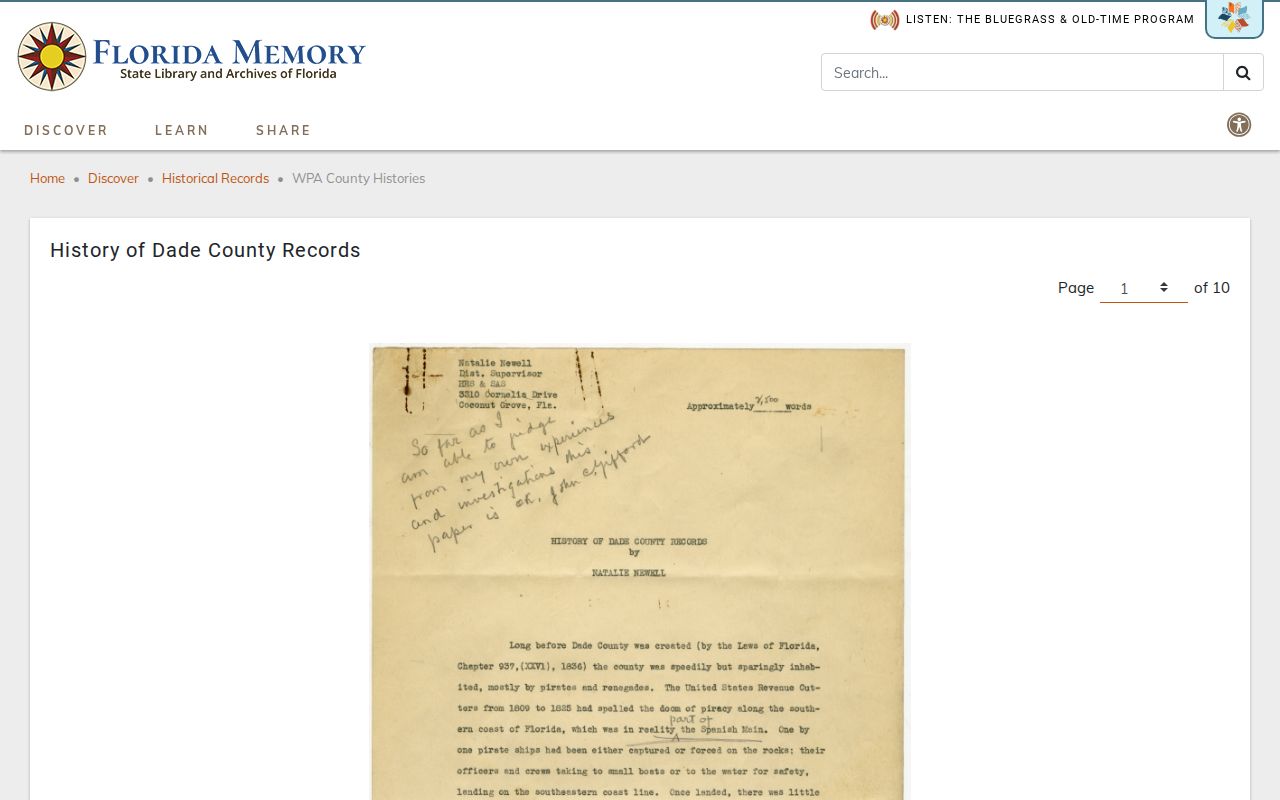
The survey helps connect modern Doral research to older Dade and Miami custody rather than suggesting that the young city kept those early books.
Doral Directory Research at MDPLS
The nearby Doral Branch can help with catalog access and general reference questions, but the deep genealogy shelf is at MDPLS Main Library. It includes city directories and telephone indexes beside more than 27,000 genealogy books and over 35,000 microforms. Most items stay in the library. Search the digital catalog first, ask an e-reference librarian to check a year, then plan an onsite visit if the needed volume or reader is only at Main.
The successful capture below comes from the library's own genealogy gateway. Open the MDPLS Genealogy Collection before visiting to see the collection description and digital entry point.
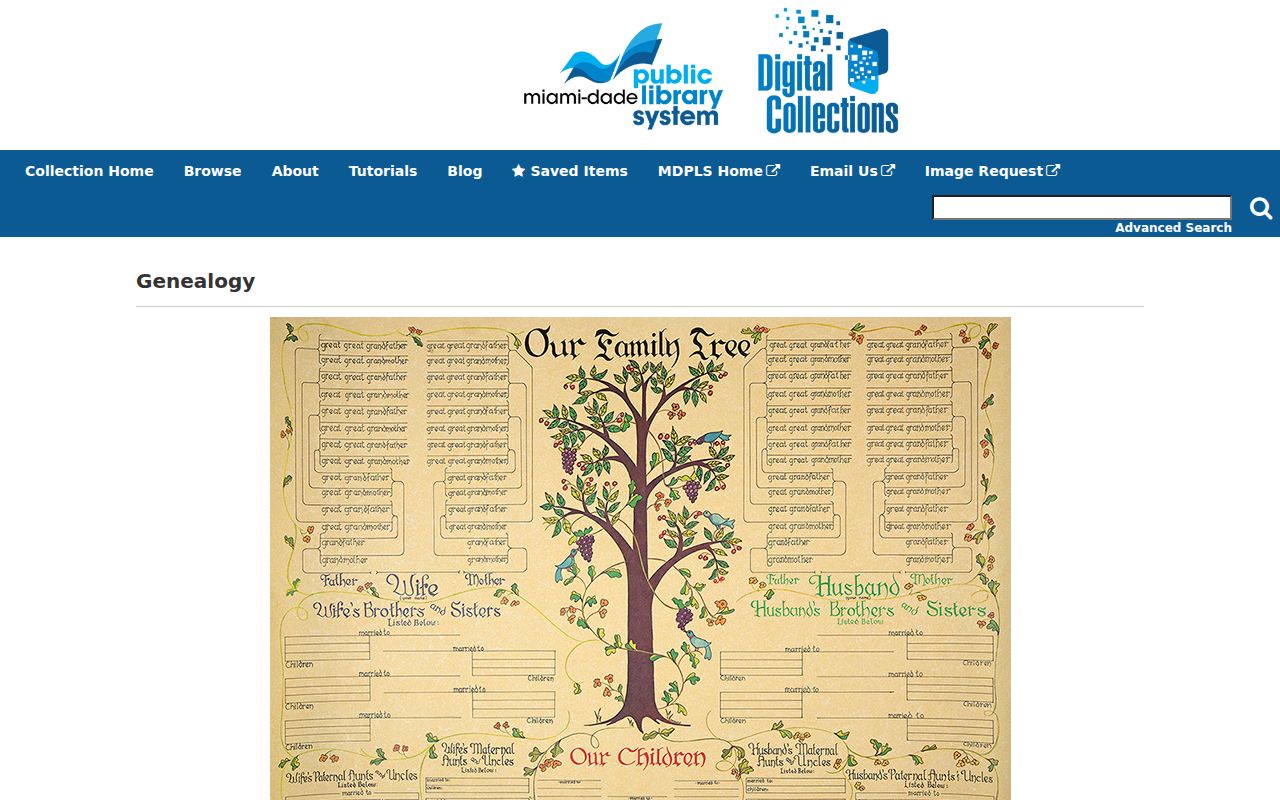
The page points Doral researchers toward the countywide shelf that actually holds the older directory evidence. If one year is absent, continue with HistoryMiami and the State Library rather than ending the search.
Note: Confirm exact directory years and call numbers with genealogy staff because the complete shelf run is not published online.
Reading Doral Directory Evidence
A period entry compresses a household into a short line. Start with the surname and given name or initial, then read every mark through the volume's own abbreviation key. A spouse may appear in parentheses. The word wid can identify a widow or widower and may name the deceased spouse. Work details can include an occupation, employer, business, or officer title. The address is a lead to compare with the street section, census, deed, or newspaper, not proof that every household member appears.
| Identity | Surname first, then given name or initials; spouse may follow in parentheses |
|---|---|
| Status | wid marks widow or widower; h marks home; b can mean boards |
| Work | Occupation, employer, business, or company title may appear |
| Place | House or boarding address; some later books add street-order sections |
| Context | The abbreviation key controls the meaning in that specific volume |
- Criss-cross directory
- A directory arranged by street and house number instead of only by surname.
- Householder index
- A list keyed to a household head or address, useful when the name spelling is unknown.
- Abbreviation key
- The publisher's legend for short forms. Save it with the entry because marks can differ by edition.
Transcribe the line exactly before expanding it. Then check the prior and next edition. A new spouse, a changed occupation, or a different address can distinguish two people with the same name. Doral's large multilingual population also makes surname variants important: try accents removed, hyphens added or removed, both parts of a compound surname, and initials.
Doral Names Beyond Directories
The Miami-Dade Obituary Index is a strong next stop when a person vanishes from consecutive editions. The index exceeds 915,000 names, though coverage varies by newspaper and name. Use the result to locate the full notice in a newspaper database or on microfilm. A notice may explain a death, identify relatives, or supply a former place that resolves a same-name problem. Probate files and cemetery records can then confirm the trail.
Other MDPLS sources add texture without replacing the entry. The Romer collection holds about 17,500 negatives and prints, chiefly from 1925 through the 1950s. The Agnew Welsh collection has 227 scrapbooks, mainly drawn from the Miami Daily News from the 1920s through the 1950s. Maps and atlases help place roads and development names. These sources are especially useful when modern Doral geography does not match the wording in an older record.
Doral Directory Archive Fallbacks
HistoryMiami's Research Center keeps city directories, yearbooks, newspapers, manuscripts, ephemera, and architectural material in a noncirculating reading room at 101 W Flagler Street. Published hours in the research are Tuesday through Thursday from noon to 4:30 p.m. and Friday from 10 a.m. to 4:30 p.m.; confirm before traveling. Staff can be reached at 305-375-1623 or archives@historymiami.org. The State Library and Archives of Florida is the next catalog and reference fallback.
The successful State Library capture shows the official statewide access point.
Use it when a Miami-Dade shelf lacks a year or when a catalog record points to a state-held copy. University of Miami Special Collections can add regional business and migration context through Model Land Company, Pan Am, photographs, and oral histories.
Doral Directory Research in Context
A January 2026 MDPLS research post showed staff pairing the 1924 and 1927 Miami directories with photographs and newspaper reports to trace changes in the Miami Anglers Club address. That practical example is a good model for Doral family research: one directory gives a point in time, while the next edition shows movement and an image or article explains what changed. It also shows why a catalog search alone is not enough.
Doral's own name combines Doris and Alfred Kaskel. Their 2,400-acre project began in the late 1950s, and the hotel and country club opened in 1962. Residential growth came much later. That history tells the researcher when to stop demanding a Doral-labeled volume and start using Miami/Dade directories, property records, resort and business sources, photographs, and later community records.
Trace Family in Doral Directories
Build a timeline rather than relying on one city directory entry. Normalize the surname first, then copy the spouse, work, and home details exactly. Consecutive editions can bracket an arrival, move, marriage, or death. The federal census adds a household snapshot at ten-year intervals, while Florida's 1935 and 1945 state censuses provide useful points between federal schedules. The public federal schedules currently extend through 1950 under the 72-year rule.
- Find the earliest likely alphabetical entry and save the volume year and abbreviation key.
- Check the edition before and after it, recording every change in spouse, work, and address.
- Use the street-order section, when the volume has one, to inspect nearby households.
- Pair 1930 directory evidence with the 1930 census, then use the 1935 and 1945 Florida schedules between federal years.
- When the name disappears, check the obituary index, newspapers, probate docket, cemetery office, and deeds.
Absence has several possible meanings. A person may have moved, died, become unlisted, changed a surname, or fallen into a missing year. Test each theory with another source. For a modern address-first task, the Doral street directory owns the county parcel and address workflow; use the historical shelf here once the address has been placed in the right era.
Note: A directory entry is evidence of a published association, not proof that every person in a household was listed.